


Summarise this blog
 ChatGPT
 Claude
 Perplexity
Key Takeaways
- Google is making Search more AI-driven, with AI Overviews and AI Mode providing more detailed, conversational answers directly in search results.
- Traditional SEO still matters, but ranking alone is no longer the only consideration. Content also needs to be clear, useful, well-structured, and easy for AI systems to understand and reference.
- Businesses should focus on helpful, original content that directly answers searchers’ questions, supported by strong technical SEO, clear site structure, and relevant internal links.
- AI search does not replace SEO. The fundamentals remain important, but businesses need to optimise for both traditional Google results and AI-powered search experiences.
At Google I/O 2026, Google announced a new era for AI Search with updates that show how search is becoming more conversational, more personalised, and more action-oriented. The announcement includes a redesigned AI-powered Search box, wider use of AI Mode, follow-up questions from AI Overviews, Search agents, and more personalised search experiences.
Google described the new AI-powered Search box as its biggest upgrade to Search in more than 25 years.
For business owners and marketing teams, this is not just another technology update. It is a clear signal that the way people search, compare, and make decisions online is changing.
People are no longer limited to typing short keywords into Google and clicking through a list of links. They can ask more detailed questions, continue a search as a conversation, use different types of input, and expect AI-powered systems to organise information for them.
This does not mean SEO is disappearing.
It means search visibility is becoming broader, more complex, and more connected to how clearly a business can explain its expertise online.
At Search Studio, we see this as an important development for every business that relies on organic visibility. Search is changing, and businesses need to understand what that shift means before it becomes the new normal.
What Did Google Announce at Search I/O 2026?
Google’s announcement focuses on bringing more advanced AI capabilities directly into Search.
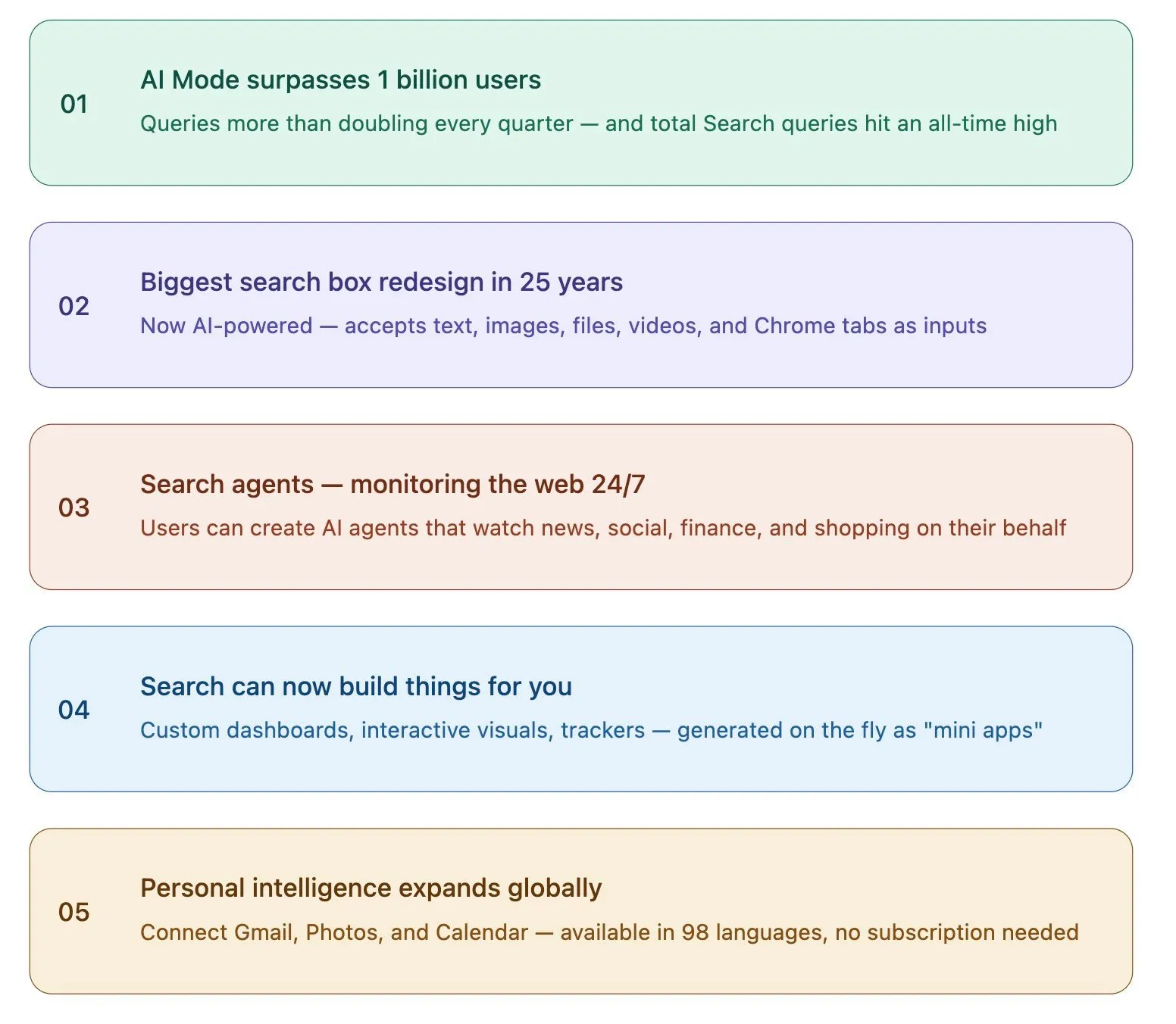
One of the key updates is the continued growth of AI Mode. Google shared that AI Mode has surpassed one billion monthly users just one year after its debut. Google also announced that Gemini 3.5 Flash is becoming the default model in AI Mode globally.
Another major update is the redesigned AI-powered Search box. Instead of only entering short search terms, users can describe what they need in more detail. Google says the new Search box will support different types of input, including text, images, files, videos, and Chrome tabs.
Google is also making it easier for users to continue from an AI Overview into AI Mode. This allows people to ask follow-up questions while keeping the context of the previous search. In other words, a search journey can become more like a conversation than a one-time query.
Another important part of the announcement is the introduction of Search agents. Google says these agents will be able to monitor information across the web, including blogs, news sites, social posts, and real-time data such as finance, shopping, and sports updates. These agents are designed to help users receive synthesised updates when relevant information changes.
Google also announced that Search will be able to create custom layouts, tables, graphs, simulations, dashboards, trackers, and mini apps directly inside Search. This shows that Search is moving beyond simply presenting results and becoming more interactive.
In simple terms, Google Search is becoming less like a directory of links and more like an AI assistant that can understand, compare, summarise, monitor, and help users take action.
What This Signals for the Future of Search

For many years, businesses have thought about SEO mainly in terms of rankings.
Google’s announcement confirms a direction that has been building for some time: search is becoming more conversational and more decision-led.
Users may not always move from a keyword to a website in the same way they used to. They may ask follow-up questions, compare several options directly in Google, rely on AI-generated summaries, or use AI agents to monitor information for them.
This does not remove the need for websites. In fact, it makes strong websites even more important.
AI-powered search experiences still need information to work from. They need clear, useful, accurate, and trustworthy content. Businesses that explain their expertise well are more likely to be understood in this new search environment.
For businesses, this means content should do more than fill a page with keywords. It should help users understand:
- What the business does
- Who the business helps
- What problems it solves
- Why it can be trusted
- How its services compare with other options
- What customers should know before making a decision
This is not about chasing every new AI feature. It is about building a stronger foundation for how your business is represented online.
Traditional SEO Still Matters
Even with these AI updates, traditional SEO is still important.
Technical SEO, keyword research, site structure, page speed, metadata, internal linking, quality content, backlinks, and user experience all continue to support how search engines crawl, understand, and evaluate a website.
What is changing is the role these elements play.
SEO is no longer only about ranking for a fixed list of keywords. It is becoming part of a wider discovery journey, where users ask more complex questions and expect clearer answers.
A service page that simply says “we provide SEO services” may not be enough. A stronger page should explain what the service includes, who it is for, what process is involved, what results are realistic, and why the business is credible.
This kind of content helps human readers. It also gives search systems better context.
How Businesses Can Prepare for This Shift

Preparing for AI-led search does not mean rebuilding a website overnight.
It means making your website clearer, more useful, and easier for both people and AI-powered search systems to understand.
Businesses should focus on strong SEO foundations, clear service pages, helpful content, visible trust signals, and better connections between related topics.
As search becomes more conversational and AI-led, the businesses that explain their expertise clearly will have a better chance of being found, understood, and trusted.
How Search Studio Is Responding

At Search Studio, we are paying close attention to these changes because they directly affect how businesses are discovered online.
Our approach to SEO has always focused on long-term visibility, clarity, and sustainable growth. Google’s latest announcement reinforces the importance of that approach.
Search visibility is no longer just about ranking for keywords on Google. It is about helping search engines, AI and users understand the full picture of a business: its services, expertise, credibility, and relevance.
That is why our SEO work continues to focus on the foundations that matter, including technical SEO, content structure, search intent, internal linking, topic depth, and trust signals.
As AI-led search continues to develop, we are also looking at how brands appear beyond traditional rankings, including AI-generated answers, AI referral traffic, and brand mentions across AI-powered discovery platforms.
The future of SEO will not be about choosing between traditional SEO and AI-led search. It will be about building a strategy that supports both.
Key Takeaways

Google’s latest announcement marks an important moment for the future of Search.
With AI Mode, AI Overviews, Search agents, a redesigned AI-powered Search box, and more personalised search experiences, Google is showing that search is becoming more conversational, more intelligent, and more action-focused.
For businesses, this is not a reason to panic. It is a reason to pay attention.
SEO is not disappearing. It is expanding.
Businesses that invest in a strong website, clear brand positioning, useful content, and a credible online reputation will be better prepared for both today’s search results and tomorrow’s AI-led discovery experiences. In the future of search, visibility will not depend on content alone. It will also depend on how clearly a brand is understood, how trusted it is across the web, and whether people naturally search for that brand when they need reliable answers.
At Search Studio, our SEO strategists are already following these changes closely and helping clients prepare for the future of search with strategies built on clarity, trust, and long-term visibility.
Frequently Asked
Questions
Book your callWhat did Google announce for AI Search at I/O 2026?
Google announced a redesigned AI-powered Search box (its biggest Search upgrade in more than 25 years), wider use of AI Mode, follow-up questions from AI Overviews, Search agents and more personalised results. Gemini 3.5 Flash becomes the default model in AI Mode globally.
What is Google AI Mode?
AI Mode is a conversational way to search: you ask questions in natural language, get AI-generated answers and can ask follow-up questions. Google says it passed one billion monthly users a year after launch.
How do AI Overviews and AI Mode affect SEO?
Search is becoming more conversational and decision-led, so users may compare options inside Google before clicking. Visibility now means being understood and cited by AI systems, not only ranking for a keyword.
Does traditional SEO still matter?
Yes. Technical SEO, keyword research, site structure, page speed, metadata, internal linking, quality content, backlinks and user experience still determine how search engines crawl, understand and evaluate your site.
How should businesses prepare for AI-led search?
Strengthen SEO foundations, make service pages clear, publish genuinely helpful content, show visible trust signals, and connect related topics on your site so both people and AI systems can understand what you offer.